The California Bearing Ratio (CBR) test remains the benchmark for assessing subgrade strength in pavement design across the UK, and its relevance in Southampton is tied directly to the variability of our local geology. BS 5930:2015 and BS EN 1997-2:2007 offer the framework, but real-world application demands an understanding of how the region's River Terrace Deposits and the Bracklesham Group respond to remoulded compaction. With the Port of Southampton's heavy traffic demands and ongoing urban expansion in areas like Woolston, accurate soaked CBR values are non-negotiable. Our laboratory procedures focus on simulating the worst-case saturation conditions typical of a Hampshire winter, ensuring the design prevents premature rutting and shear failure. Before committing to a full pavement design, many engineers correlate these results with in-situ plate load testing to validate the assumed modulus of subgrade reaction on site.
A 2.5% CBR at 95% relative compaction in saturated Southampton brickearth typically dictates a capping layer thickness exceeding 600mm under Series 900.
Technical details of the service in Southampton
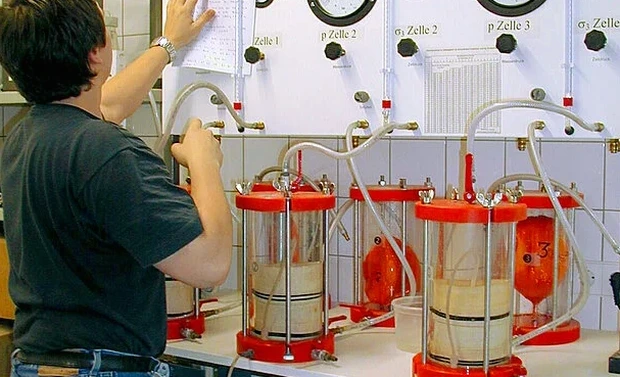
Field demonstration
Risks and considerations in Southampton
One practical observation from testing Southampton soils is the over-reliance on unsoaked CBR values for design. We frequently see site-won London Clay classified as 'stiff' during summer site investigations, only to drop to a 'soft' consistency after the autumn rains, cutting the design CBR by more than half. Omitting the laboratory soak transforms a cost-effective capping reduction into a long-term rutting liability. The financial impact of a failed pavement on a Southampton distribution centre yard, where HGV traffic is constant, easily dwarfs the cost of a proper geotechnical investigation. Another frequent oversight is ignoring the sulphate content in the groundwater; a high CBR value doesn't protect the sub-base if the stabilised layer is attacked by chemical ground conditions.
Our services
Our Southampton laboratory workflow handles the full life cycle of CBR testing, from sample extrusion to final reporting.
Soaked Laboratory CBR Determination
Full compliance with BS 1377-4, including 4-day soak, swell monitoring, and penetration testing using a calibrated load frame. Suitable for fine-grained and granular subgrade materials.
CBR Value Assessment for Recycled Aggregates
Testing of 6F2, 6F5, and other recycled capping materials per SHW Series 800, ensuring they meet the 15% minimum CBR threshold for Southampton City Council adoptable works.
Questions and answers
Why is the 4-day soak essential for a CBR test in Southampton?
The 4-day soak simulates the long-term saturated condition of the pavement formation. Given Southampton's high water table, particularly in areas like Redbridge near the River Test, skipping this soak results in an artificially high CBR value. The standard mandates fully submerging the specimen to replicate winter groundwater levels, ensuring the pavement's structural integrity year-round.
What is the typical cost of a laboratory CBR test in the Southampton area?
For a standard soaked CBR test (3-point compaction curve) on a single sample, the cost typically ranges from £110 to £180, depending on the soil type and the specific sample preparation requirements outlined in BS 1377.
Which British Standards govern the CBR test procedure in the UK?
The primary standard is BS 1377-4:1990, which details the compaction-related tests. For pavement applications, BS EN 13286-47 provides additional context for unbound mixtures. The overarching ground investigation framework is managed under BS 5930:2015 and Eurocode 7 (BS EN 1997-2:2007).
What CBR value is typically required for residential roads in Southampton?
Southampton City Council generally requires a minimum subgrade CBR of 2.5% for residential adoptable roads under S38 agreements. If the laboratory-soaked result falls below this, a capping layer is required. For heavier commercial access roads near the Western Docks, a design CBR of 5% or greater is often specified to handle port traffic.