One of the most common mistakes we see on sites across Southampton is treating the whole city as a uniform seismic hazard zone. The reality is far more complex. A site near the River Itchen on soft alluvium responds very differently to a site on the Bracklesham Beds in the northern suburbs. Our laboratory team processes the data, but the core insight comes from understanding these local geological contrasts. A standard desk study often misses the amplification potential of the thick, saturated clays underlying the city centre. By integrating borehole data from spt-drilling with geophysical surveys, we build a ground model that predicts how the soil column will behave during a low-probability but high-impact event, ensuring your foundation design reflects the actual site-specific risk rather than a generic code assumption.
Site-specific amplification factors in the Test and Itchen valleys often exceed the default UK National Annex values by a significant margin.
Technical details of the service in Southampton
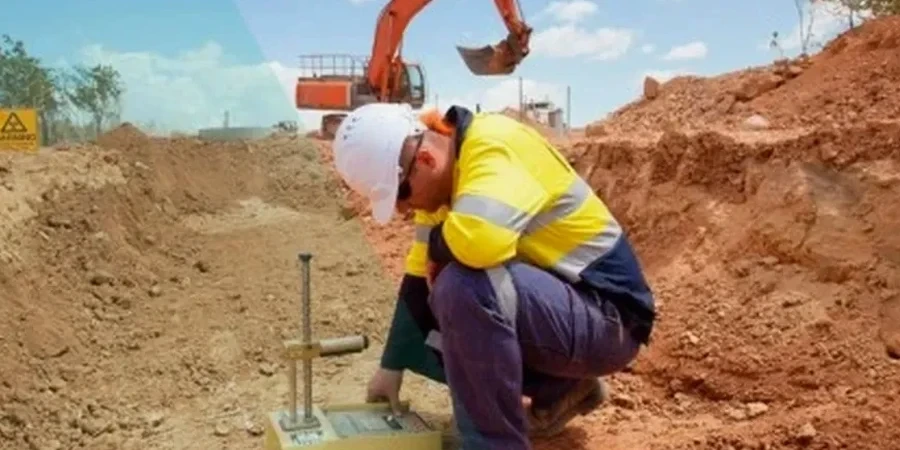
Risks and considerations in Southampton
The risk profile shifts dramatically between the gravel terraces of Shirley and the reclaimed marshland of the Western Docks. In Shirley, the dense, sandy gravels overlying the London Clay offer a relatively stiff response, keeping amplification low. Down in the docks, the deep sequence of soft organic silts and peats presents a classic basin-edge effect. We've measured Vs30 values below 180 m/s there, placing it firmly in ground type D or E. The real danger isn't just the shaking; it's the potential for liquefaction in the saturated, loosely compacted hydraulic fills used to extend the port area. A microzonation study maps these boundaries precisely, so you don't design a piled foundation for a terrace site or underestimate the ductility demand in the port.
Our services
A seismic microzonation study in Southampton involves a phased approach, from initial geological modelling to final response spectra. Our lab handles the data processing and reporting, ensuring compliance with UK regulatory expectations for complex sites.
Site-Specific Response Analysis
We build a ground model from borehole logs and shear wave velocity profiles, then perform 1D equivalent-linear analysis using SHAKE or DEEPSOIL to generate surface response spectra. This replaces the generic site factors from the National Annex with values calibrated to the soil column beneath your Southampton site.
Seismic Hazard Mapping
For larger developments spanning multiple ground conditions, we produce microzonation maps showing the spatial variation of PGA, spectral acceleration, and amplification factors. These maps are integrated into the ground investigation report to guide foundation design across the site.
Questions and answers
What is the typical cost of a seismic microzonation study in Southampton?
The cost for a seismic microzonation study in the Southampton area typically ranges from £3,040 to £12,730, depending on the number of boreholes requiring downhole seismic testing, the extent of the MASW survey grid, and the complexity of the ground model. A small single-building site with one Vs profile and basic analysis will be at the lower end of this range, while a large multi-hectare development with variable geology and 2D analysis will be at the higher end.
Why is seismic microzonation necessary in a low-seismicity region like the UK?
While the UK is not on a plate boundary, Southampton sits within the Wessex Basin, a region with deep sedimentary deposits that can significantly amplify seismic waves from distant events. The soft alluvium and artificial fill along the Test and Itchen estuaries create site conditions where the surface motion can be several times stronger than the bedrock motion. BS EN 1998 requires site-specific studies when ground conditions are unfavourable, and ignoring this can lead to underestimated lateral loads on structures.
What geophysical methods do you use to measure shear wave velocity?
We primarily use the downhole seismic method in a cased borehole to measure shear wave velocity (Vs) directly at discrete intervals. This is often combined with a surface-based MASW survey to offer a continuous 2D Vs profile between borehole locations. In Southampton's urban environment, the MASW setup must account for space constraints and background noise, so we use short geophone arrays and repeat shots to improve the signal-to-noise ratio.