You see it often driving up the Avenue towards the M3: a new housing development carved into a gentle slope, or an old railway cutting showing signs of weathering. We recently reviewed a slope behind a Victorian terrace in Portswood where garden creep had exposed a section of the Wittering Formation, a sandy clay layer notorious for losing strength when saturated. The developer needed to know if a two-storey extension was viable without triggering a rotational slip. Our analysis, incorporating in-situ permeability testing to understand drainage conditions, showed that a modest toe drain and a slight regrade would offer sufficient long-term stability. In Southampton's variable geology, a desk-based assumption is rarely enough; you must get on site, understand the groundwater, and test the material's residual strength.
In Southampton's coastal slopes, the difference between a stable cut and a failure is often just a few degrees of effective friction lost to pore pressure build-up during a wet winter.
Technical details of the service in Southampton
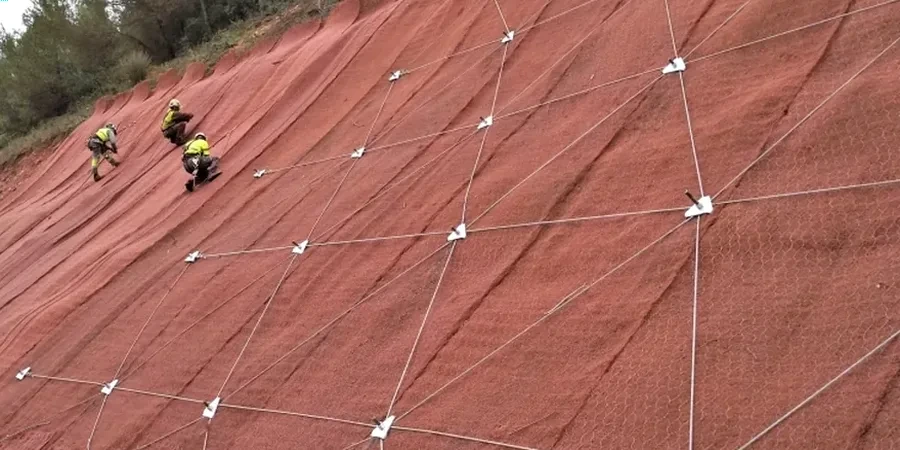
Risks and considerations in Southampton
The risk profile changes dramatically between a site in Bassett, sitting on the firm London Clay plateau, and one near Ocean Village, founded on soft alluvium and made ground. In Bassett, the main concern is long-term degradation of strength in cut slopes; the clay there was overconsolidated by hundreds of metres of now-eroded cover, so it wants to relax and crack. Down by the water, you are dealing with a completely different beast: loose silty sands and soft clays that can fluidise under cyclic loading from dredging or traffic. We once compared two retaining structures built in the same year: a gravity wall in the city centre that had barely moved, and a sheet pile quay wall in Northam that had rotated seaward by 80mm because the passive zone hadn't been properly assessed. The lesson? Uniform application of a generic 'safe' angle is a false economy here.
Our services
Our slope stability work in Southampton is not a standalone exercise. It is typically integrated with a wider ground investigation campaign designed to answer specific design questions for the local geology.
Deep-Seated and Translational Failure Analysis
We model complex failure mechanisms through the Wittering Formation and into the underlying London Clay, using limit equilibrium and finite element methods to evaluate both temporary works cuts and permanent slopes.
Coastal Slope and Cliff Recession Studies
For properties and infrastructure along the Southampton Water foreshore, we assess the rate of cliff retreat and the risk of shallow flowslides in the weathered Bracklesham Beds, informing erosion control strategies.
Questions and answers
What is a typical slope stability analysis cost for a small residential project in Southampton?
For a residential extension or a small cut slope in the Southampton area, a slope stability assessment generally falls between £960 and £2,840. The final fee depends on whether we need to commission new triaxial tests or can work with existing borehole data, and the complexity of the groundwater regime.
How does the presence of the Bracklesham Beds affect slope stability in Southampton?
The Bracklesham Group contains sand layers that act as aquifers. When water seeps through these sands and hits an underlying clay layer, it creates a perched water table that significantly reduces effective stress. We look specifically for this in our analysis because it is the trigger for many shallow landslides in the northern suburbs.
Can you analyse an existing failed slope to determine the cause?
Yes, forensic back-analysis is a core part of our practice. By measuring the actual slip surface geometry and performing a sensitivity analysis on pore pressure, we can determine whether the failure was triggered by excessive rainfall, an under-designed cut angle, or a surcharge that wasn't considered.
What partial factors do you apply under Eurocode 7 for Southampton soils?
We follow the UK National Annex. For persistent design situations, we typically apply a partial factor on effective cohesion (c') of 1.25 and on the tangent of the effective friction angle (tan φ') of 1.25. For undrained strength, the factor is usually 1.40, which is often the governing case for short-term cuts in London Clay.