BS 5930:2015+A1:2020 and Eurocode 7 (BS EN 1997-2:2007) form the backbone of ground investigation practice in the UK, and nowhere is their application more critical than in Southampton. The city sits on a complex sequence of Bracklesham Group clays, sands, and gravels overlying the White Chalk Subgroup, with thicknesses varying dramatically between the river valleys and the upland gravel terraces. A CPT test provides continuous in-situ measurements of cone resistance and sleeve friction, generating a near-real-time stratigraphic profile that a borehole alone cannot match. On the redevelopment plots around Ocean Village or the industrial quays along the River Itchen, where made ground and alluvium mask the natural strata, the cone penetration test reveals soft lenses and transition zones that would otherwise go undetected. The data feeds directly into pile design parameters and liquefaction assessments under seismic loading scenarios outlined in Eurocode 8. For sites near the tidal River Test, we often combine CPT results with a triaxial test to validate the undrained shear strength profile in the soft alluvial clays that underpin much of the city centre.
A single CPT sounding replaces multiple boreholes for stratigraphic profiling, delivering continuous qc and fs data at 10 mm intervals that no SPT can replicate.
Technical details of the service in Southampton
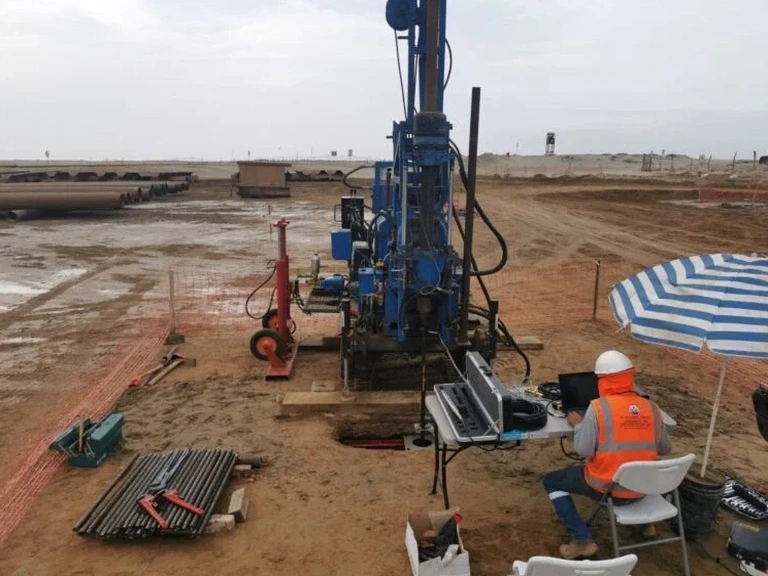
Risks and considerations in Southampton
Southampton's development history presents a geotechnical challenge that makes CPT data indispensable. The medieval town grew around the tidal confluence of the Test and Itchen, and centuries of dock expansion, bomb damage from the Blitz, and post-war reconstruction left a patchwork of filled ground across the city centre. Beneath the modern paving of West Quay and the Central Station approach, thicknesses of made ground exceeding 4 metres are common, often containing brick rubble, timber piles from former quays, and uncompacted ash fill. A CPT sounding penetrates this heterogeneous layer and detects the transition to natural alluvium or river gravel with a clarity that disturbed borehole samples cannot offer. The risk of differential settlement is acute where old dock structures were backfilled inconsistently, and the cone resistance profile identifies zones of low stiffness that require targeted ground improvement. Without this continuous record, foundation designs rely on interpolation between sparse boreholes, a gamble that has led to costly over-excavation and redesign on more than one Southampton project. On sites within Flood Zone 3 along the River Itchen corridor, where saturated granular soils are susceptible to earthquake-induced liquefaction, the CPT-based method from Seed and Idriss (1971) remains the most solid approach for calculating the factor of safety.
Our services
CPT testing in Southampton integrates with complementary ground investigation methods to build a complete geotechnical model. The activities below are typically combined on a single project to address specific design questions:
Piezocone (CPTU) with Dissipation Testing
Equipped with a pore pressure transducer at the u2 position, the piezocone measures excess pore water pressure during penetration. In Southampton's alluvial clays, dissipation tests at target depths yield the coefficient of consolidation (cv) for settlement-rate calculations, directly applicable to raft foundation design on soft ground.
Seismic CPT (SCPT)
A geophone module added to the cone string measures shear wave velocity (Vs) at 1-metre intervals during pauses in penetration. The Vs profile feeds directly into site classification per Eurocode 8 and small-strain stiffness (Gmax) for finite-element settlement analysis, particularly valuable for the stiff Bracklesham clays where high Vs contrasts occur.
CPT with Soil Sampling Verification
While CPT provides continuous stratigraphy, discrete samples are still needed for index testing and strength calibration. We pair CPT soundings with targeted window-sampler or cable-percussion boreholes at strategic locations, using the cone data to select sampling depths in the most critical strata, reducing total investigation cost by up to 30% compared to a borehole-only programme.
Questions and answers
How deep can a CPT rig penetrate in Southampton's ground conditions?
It depends entirely on the strata encountered. In the soft alluvial clays and silts of the River Test floodplain, 25 to 30 metres is achievable with a 20-tonne reaction rig. However, the River Terrace Gravels found across much of north Southampton (Bassett, Highfield, Portswood) can halt penetration at 6 to 10 metres if the gravel is dense and the clast size exceeds 40 mm. A site-specific assessment based on available geological mapping and nearby borehole logs determines whether CPT is appropriate for the target depth, or whether a hybrid approach with cable-percussion boreholes is needed to penetrate the gravel cap.
What is the cost of a CPT test in Southampton?
A single CPT sounding in the Southampton area typically ranges from £140 to £200 per metre, inclusive of mobilisation, cone calibration, data acquisition, and a factual report with soil behaviour type classification. The final rate depends on the number of soundings per mobilisation, the target depth, and whether piezocone or seismic modules are required. A typical day's work comprising three 20-metre soundings would produce a comprehensive site profile for a medium-sized development plot.
Can CPT testing distinguish between chalk and overlying soils in Southampton?
Yes, and it does so with exceptional clarity. The White Chalk Subgroup underlying Southampton produces a sharp increase in cone resistance, often exceeding 25 MPa within a few centimetres of the contact, accompanied by a drop in friction ratio below 1%. When using a piezocone, the pore pressure response also changes markedly at the chalk interface. This diagnostic signature makes CPT one of the most reliable methods for mapping chalkhead depth across a site, which is critical for pile design where socket length into competent chalk governs axial capacity.
What are the limitations of CPT compared to traditional boreholes?
CPT does not recover physical soil samples, so it cannot directly measure moisture content, plasticity index, or perform laboratory strength tests. Gravels with clasts larger than about 50 mm can cause refusal or damage the cone. In Southampton, the main limitation is the River Terrace Gravels, which may prevent reaching the underlying Bracklesham Group clays. For sites requiring contamination testing or detailed mineralogical analysis, CPT should be supplemented with targeted sampling boreholes. The combination of continuous CPT profiling with a reduced number of boreholes is often the most cost-effective investigation strategy.
How quickly can CPT results be delivered for a Southampton project?
A factual report including corrected qc, fs, Rf profiles, soil behaviour type classification per Robertson (1990), and pore pressure dissipation curves is typically delivered within 3 to 4 working days of completing the fieldwork. For time-sensitive projects, preliminary data plots can be made available within 24 hours. Interpretative reports with geotechnical design parameters, pile capacity estimates, and liquefaction assessments require additional engineering analysis and are scoped according to the project requirements.