Southampton's medieval walls didn't have deep foundations. They sat on the stiff Bagshot Sand, which worked well enough for the 14th century. Modern construction on the same geology is a different story. The city's expansion from the docks northward into the Chilworth and Bassett areas means you encounter London Clay, river gravels, and made ground within a single site. An exploratory test pit cuts through that complexity fast. Our team opens a trench to 1.2–2.5 m depth, logs the strata against BS 5930:2015, and photographs the contact between natural gravel and the overlying fill. For projects near the River Itchen where soft alluvium appears within 800 mm of the surface, we often pair the pit log with a CPT test to extend the profile beyond reachable depth. The visual record from the pit gives your structural engineer the context they need to set footing levels without guesswork.
A test pit in Southampton river gravel gives you a bearing stratum and a drainage path in one excavation. That is two design parameters for the cost of one.
Technical details of the service in Southampton
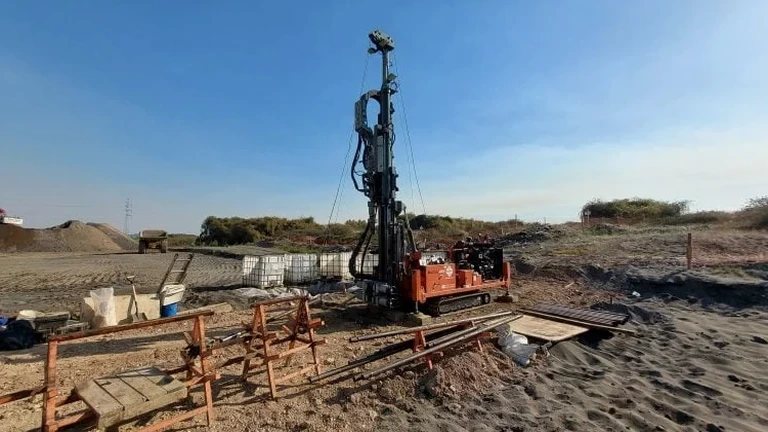
Field demonstration
Risks and considerations in Southampton
In Southampton, we often see test pits terminated too early in the gravel terrace. The operator hits large cobbles at 1.4 m, assumes refusal, and the log reads 'gravel, dense, end of pit'. The problem is that the natural gravel continues another 600 mm to the London Clay contact, and the cobble layer is just a lag deposit. If you stop there, your foundation sits on a thin gravel lens over softer clay, and differential settlement shows up within three years. Our team knows the difference between true refusal in the Bracklesham cemented sandstone and a temporary obstruction. We dig a second pit offset by 1.5 m to confirm the contact. Another local issue is groundwater in the made ground along the old docklands: a pit that fills with water within 20 minutes tells you as much about the drainage design as a permeability test, and we record that observation in the field notes.
Our services
The test pit is a versatile tool on Southampton sites. It answers questions about bearing capacity, drainage, and buried obstructions in a single morning. The four activities below cover the most common requests we receive from structural engineers and architects working in the city.
Foundation inspection pits
Excavation adjacent to existing footings to verify depth and condition. Common for loft conversions and extensions in the Polygon and Highfield conservation areas where original plans are unavailable.
Soil profiling for new builds
Full-sequence logging of strata from topsoil to bearing stratum. We identify the transition from made ground to natural deposit, a critical line for NHBC warranty acceptance.
Bulk sampling for laboratory testing
Collection of 25 kg disturbed samples from each stratum. Sealed and labelled to BS 5930 for subsequent classification testing at our UKAS-accredited partner lab.
Percolation test pits
Soakaway testing in accordance with BRE Digest 365. We excavate to proposed invert level, fill with water, and record the drop rate over the required period for SuDS design.
Questions and answers
What depth can you reach with a test pit in Southampton?
The standard reach is 2.5 m with a 3-tonne excavator. In the river terrace gravels near the city centre, occasional cobble layers may limit depth to 1.8 m. For sites on London Clay in Bassett or Chilworth, we typically achieve the full 2.5 m without refusal. If you need deeper information, we recommend supplementing the pit with a window sampler borehole.
How soon after the pit is dug do I get the log?
You receive a digital field log with photographs the same day, sent by email before the excavator leaves site. The formal report with strata descriptions to BS 5930, interpretation notes, and laboratory sample chain-of-custody follows within 48 hours.
Do you handle the CAT scan and service location before digging?
Yes. We arrange a CAT and Genny sweep of the pit locations before the excavator arrives. If the sweep indicates a buried service within 500 mm of the planned pit, we shift the location and re-mark. The sweep report is included in the final documentation package.
What does an exploratory test pit cost in Southampton?
For a single pit to 2.0 m depth with full BS 5930 logging, photographs, and a summary report, budget between £360 and £720. The range depends on access constraints, the number of pits on the same mobilisation, and whether laboratory testing of samples is required.