Compaction verification on Southampton’s variable subsoils demands strict adherence to the Specification for Highway Works (Series 600) and BS 1377-9. The city’s geology transitions rapidly from the Bracklesham Group clays and sands in the northern suburbs to the softer alluvial deposits of the River Test and Itchen floodplains, where residential and logistics developments are concentrated. A plate load test provides modulus values for foundation design, but the sand cone method remains the definitive site control for relative compaction when placing engineered fill. Our team applies the sand replacement procedure using calibrated Ottawa-type sand across docklands regeneration sites, school extensions, and the new Freeport infrastructure, delivering results within hours to keep earthworks programmes on track. The method is particularly relevant where the groundwater table sits within 1.5 m of formation level, a recurring challenge in this coastal city of over 250,000 residents.
On the silty sands of the Lower Bramble Bank member, a 1 percent drop in compaction can double the settlement risk beneath a heavily trafficked haul road.
Technical details of the service in Southampton
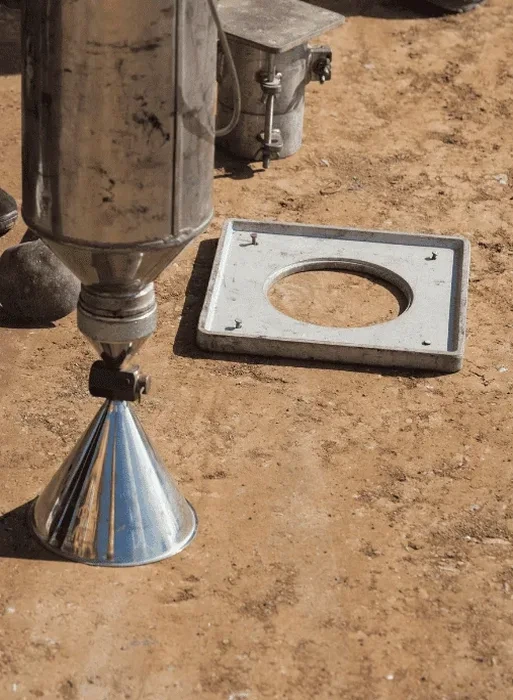
Field demonstration
Risks and considerations in Southampton
On the alluvial clays flanking the River Itchen near St Denys, we often see contractors surprised by moisture content variations between the top 100 mm and the underlying lift. A sand cone test taken at 250 mm depth can reveal a compaction of just 88 percent while the surface appears tightly rolled—this is classic ‘crusting’ where the drum seals the surface but leaves the lower portion uncompacted. In Southampton’s maritime climate, with 750 mm of annual rainfall, this trap becomes acute during autumn earthworks when surface drying is minimal. The consequence is differential settlement beneath floor slabs and service trenches within the first two years. Specifying a minimum of three sand cone tests per 500 m² per lift, as recommended by the NHBC Standards for housing sites, catches these weak spots before they become latent defects. On larger commercial platforms near Nursling, we couple density testing with stone columns where the underlying peat requires deep improvement.
Our services
Our field density service in Southampton covers the full compaction verification cycle, from laboratory Proctor reference testing to on-site sand cone measurements.
Laboratory Proctor Determination
We establish the reference maximum dry density and optimum moisture content using the 2.5 kg or 4.5 kg rammer method in our temperature-controlled soils lab, essential before any field density comparison.
Site Sand Cone Testing
Mobile teams deploy to earthworks sites across Hampshire, performing BS 1377-9 sand replacement tests on formation levels, trench backfill, and capping layers with same-day written reports.
Compaction Compliance Reports
We compile results into clear compliance statements referencing your project specification, highlighting non-conformances and recommending re-rolling or moisture conditioning where necessary.
Questions and answers
What is the typical cost for a sand cone density test in the Southampton area?
For sites within the Southampton travel zone, a single sand cone test with full reporting typically ranges from £90 to £120, depending on the number of tests scheduled per day and access conditions. Mobilisation charges may apply for single-test visits to the outskirts like Totton or Hedge End.
How does the sand cone method differ from a nuclear density gauge?
The sand cone is a direct volumetric method: you physically excavate soil, weigh it, and measure the hole volume with calibrated sand. It avoids the radiation safety protocols and moisture interference issues that nuclear gauges suffer on Southampton’s high-organic estuarine clays. However, a sand cone test takes about 20 minutes per location versus a few minutes for a nuclear gauge.
When is density testing required under the NHBC Standards?
NHBC Chapter 4.1 requires compaction verification on all engineered fill beneath homes. For general fill, aim for a minimum of one test per 500 m² per compacted lift. For road sub-base and drainage bedding, testing frequency increases, often to one test per 50 linear metres of trench backfill. We advise clients to confirm the required frequency with their warranty provider before starting earthworks.