The Bracklesham Beds and London Clay formations beneath Southampton create a complex geotechnical profile where effective stress parameters cannot be guessed. With groundwater perched in the River Terrace Deposits and soft organic silts along the Test and Itchen estuaries, undrained shear strength values shift dramatically from one borehole to the next. The triaxial test remains the only reliable method for measuring the friction angle and cohesion intercept that structural designers actually need. Before committing to deep foundations in the city centre regeneration zones, we typically combine triaxial testing with a CPT test to correlate continuous in-situ data with laboratory-measured strength, and then run a slope stability analysis when excavations cut into the weathered Barton Clay at sites near the docks.
A £300 triaxial test that captures true effective stress parameters can reduce foundation concrete volume by 12% compared to conservative empirical correlations.
Technical details of the service in Southampton
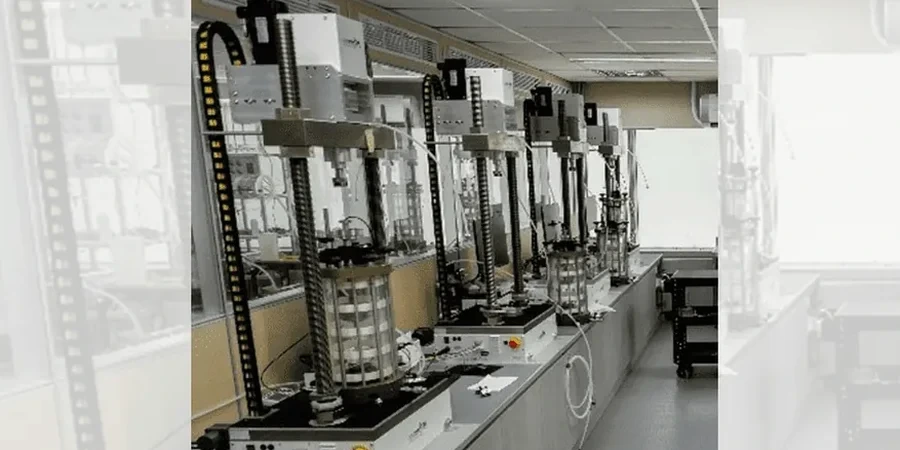
Risks and considerations in Southampton
In Southampton, we frequently encounter projects where the ground investigation report includes only unconfined compressive strength or hand vane data for the London Clay—and the designer applies a blanket undrained shear strength of 75 kPa across the site. That shortcut collapses the moment excavation reaches the water-bearing gravel lenses within the clay. A proper triaxial test programme reveals strength anisotropy and post-peak softening that peak-strength correlations completely miss. The risk multiplies near the waterfront, where tidal fluctuations in the River Test create cyclic pore pressure changes that degrade the effective friction angle over time. Ignoring triaxial data for a basement excavation in Chapel or Ocean Village can produce a retaining wall design that is either dangerously under-conservative or wastefully over-designed—both outcomes that a single stage of CU triaxial tests would have prevented.
Our services
Our triaxial testing programme in Southampton covers the full range of strength measurement needs, from simple UU checks on short-term stability to advanced stress-path testing for numerical modelling.
Multi-stage CU triaxial
Three consolidation stages on a single specimen produce a full Mohr-Coulomb envelope from one sample. Ideal for sites with limited recovery, common in the fractured zones of the Bracklesham Group.
Consolidated-drained (CD) testing
Slow-strain-rate drained tests for granular materials and stiff overconsolidated clays where long-term effective stress parameters govern the design of permanent works.
K₀ consolidated triaxial
Anisotropic consolidation to in-situ stress ratios before shearing. Essential for accurate stiffness parameters when modelling deep excavations in Southampton's urban centre.
Stress-path testing
Programmed stress paths following field loading sequences. Used for settlement prediction beneath large raft foundations on the River Terrace Deposits.
Questions and answers
How much does a triaxial test cost in Southampton?
Our standard triaxial test programme ranges from £1,710 to £1,880, depending on whether you need a single UU set, a multi-stage CU with pore pressure measurement, or a full CD suite. Multi-specimen programmes for larger investigations attract volume pricing.
What soil types in Southampton require triaxial testing?
The London Clay, Bracklesham Beds, and Lambeth Group clays all require triaxial testing when effective stress parameters are needed. The river terrace gravels can be tested in the CD configuration if undisturbed sampling is possible, though large-diameter specimens are often necessary.
How long does a consolidated-undrained triaxial test take?
A single CU triaxial test with pore pressure measurement typically requires 5 to 7 days for saturation, consolidation, and shearing at the correct strain rate. Multi-stage tests extend this by approximately 2 days per additional stage. Reporting follows within 7 to 10 working days.
Which standard governs triaxial testing in the UK?
BS 1377-7:1990 is the primary standard for triaxial compression testing. BS 5930:2015 provides the overarching ground investigation framework, and BS EN 1997-2:2007 (Eurocode 7 Part 2) specifies requirements for laboratory testing in geotechnical design.
Can triaxial data be used directly in PLAXIS or other FEM software?
Yes. We offer the stress-strain data, pore pressure response, and effective stress paths in digital format compatible with PLAXIS, ABAQUS, and FLAC. For advanced constitutive models like Hardening Soil, we can run additional oedometer and triaxial unloading-reloading stages to capture stiffness parameters.