BS 5930 and Eurocode 7 offer the framework for reliable geotechnical investigation, but the real value lies in precise execution. Across Southampton, the Bracklesham Beds and London Clay formations present soils where the plastic and liquid limits dictate everything from foundation depth to earthworks specification. The city's position on the Solent estuary means groundwater levels shift with tidal influence, altering the moisture content of near-surface cohesive soils. A single decimal point error in an Atterberg limits test can cascade into over-designed retaining structures or under-estimated settlement. Our laboratory processes samples from sites along the Itchen waterfront to the chalk uplands of Portswood, delivering classification data that geotechnical engineers rely on for slope stability assessments and slope-stability calculations where clay plasticity governs failure risk.
In Southampton's tidal-influenced clays, the difference between a liquid limit of 45% and 55% can double the predicted settlement under load.
Technical details of the service in Southampton
Risks and considerations in Southampton
Southampton's population exceeds 270,000, and the city's expansion into redevelopment zones like the former Ford plant site at Swaythling means construction on historically disturbed ground is accelerating. Fill materials on brownfield sites rarely behave as expected. A contractor who assumes a 'low plasticity clay' without Atterberg limits verification risks placing shallow footings on soil that softens dramatically when wet. The Solent's maritime climate delivers over 800 mm of annual rainfall, and prolonged wet winters can raise the natural moisture content of foundation soils above the plastic limit. In structural terms, that means loss of bearing capacity and differential settlement. The test provides a £60-£70 insurance policy against misclassification that could otherwise lead to costly remedial work or regulatory non-compliance with BS 5930.
Our services
Our Southampton laboratory provides Atterberg limits testing as a standalone service or as part of a wider site investigation package. Samples are processed by technicians familiar with the regional geology.
Standard Atterberg Limits
Liquid limit and plastic limit determination on cohesive soil samples, with full BS 5930 classification and A-line chart presentation.
Shrinkage Limit Testing
Additional parameter for soils prone to volume change during drying, particularly relevant for earthworks in Hampshire's seasonally desiccated clays.
One-Point Liquid Limit
Rapid screening using the cone method for projects requiring preliminary classification across large site areas before full investigation.
Questions and answers
How much do Atterberg limits tests cost in Southampton?
Standard Atterberg limits testing (liquid limit and plastic limit) on a single sample typically costs between £60 and £70. Volume discounts apply for projects with multiple samples, and we can offer a fixed-quote package when combined with other classification tests like particle size distribution.
Which soils require Atterberg limits testing?
Any fine-grained, cohesive soil — clays and silts — should be tested. Under BS 5930, if more than 35% of the material passes the 425 µm sieve, Atterberg limits are essential for classification. Southampton's London Clay, Bracklesham Beds clays, and the alluvial silts along the Itchen and Test estuaries all fall into this category.
What is the difference between the cone penetrometer and Casagrande cup methods?
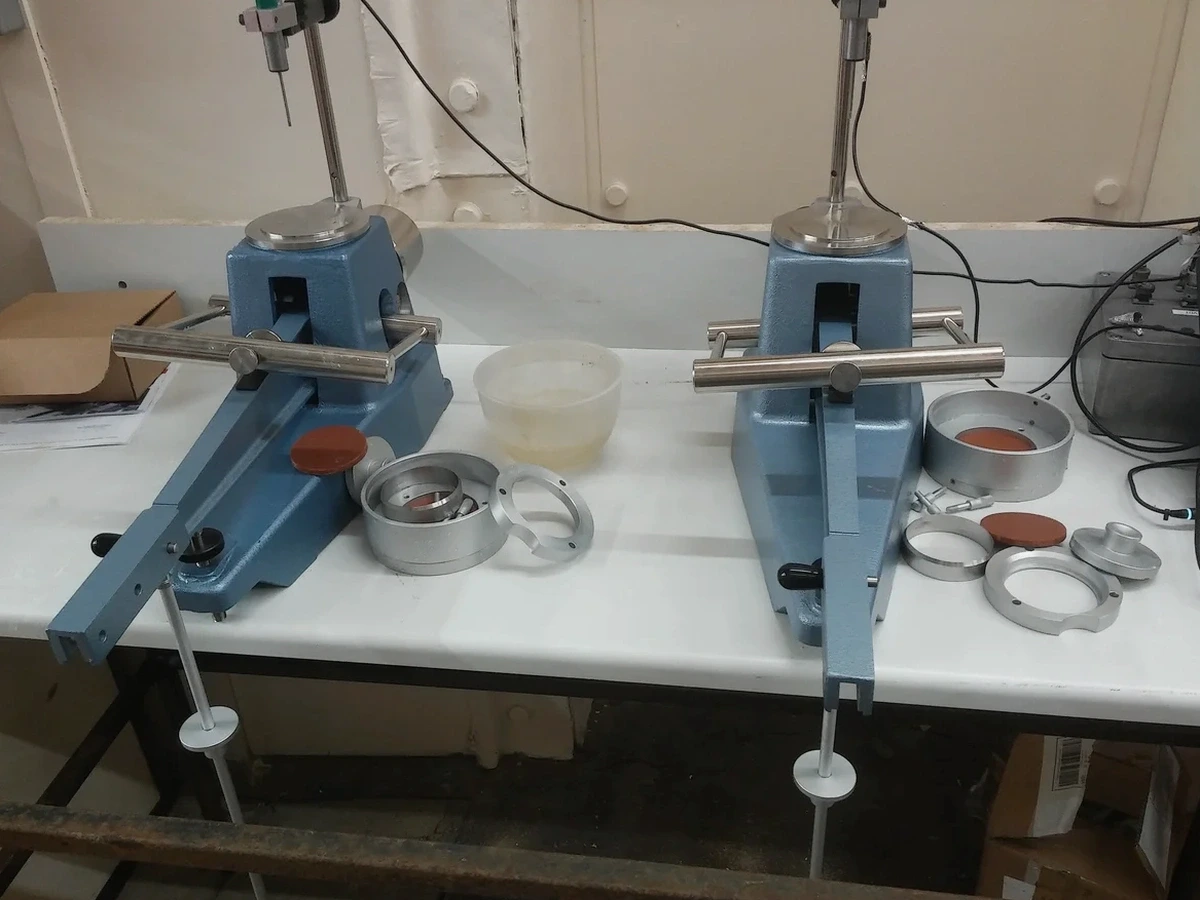
The cone penetrometer method (BS EN ISO 17892-12) is the preferred technique in the UK because it is less operator-dependent than the traditional Casagrande cup. We use the cone method as standard but can perform Casagrande cup testing for projects where international specifications require it, or where comparisons with historical data are necessary.
How soon can I get test results?
Standard turnaround is 3 to 5 working days from sample receipt. For time-critical projects in Southampton, we offer a 48-hour expedited service. The timeline depends on the natural moisture condition of the samples — air-drying prior to testing is part of the procedure and cannot be rushed without compromising accuracy.