The underlying geology in Southampton shifts dramatically within short distances. A project near the docks sits on soft alluvium and reclaimed marshland over the Bracklesham Beds, while a site north of the M27 might encounter the stiff, overconsolidated London Clay with bands of claystone. The water table is consistently high, often less than 2 metres below ground level in the Itchen and Test river corridors, which directly impacts effective stress calculations in any soil mechanics study. We run our triaxial cells and oedometers to measure drained and undrained shear strength, because using generic parameters for the Lambeth Group sands has led to excessive settlement in several local framed structures. For granular layers where sampling is difficult, we combine the lab programme with a CPT test to capture continuous tip resistance and pore pressure data without disturbing the insitu fabric.
London Clay preconsolidation pressures in central Southampton often exceed 600 kPa, meaning low-rise foundations operate well within the overconsolidated range—until a basement excavation removes the surcharge.
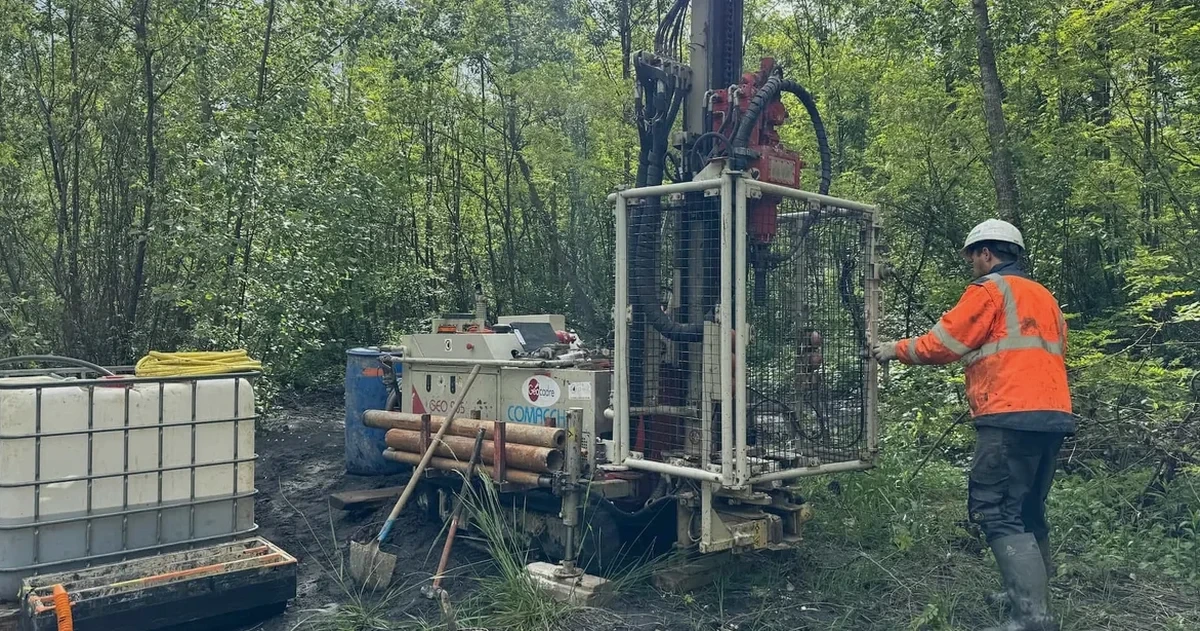
Technical details of the service in Southampton
Risks and considerations in Southampton
The most common mistake we see is designers applying undrained parameters from a single UU triaxial on a disturbed sample to a long-term, drained problem. In the London Clay Formation, the drained strength envelope is nonlinear, and using a constant friction angle from 50 kPa to 400 kPa normal stress overpredicts the bearing capacity by a significant margin. We caught this on a Southampton student accommodation block where the initial pad footing design gave a factor of safety of 1.1 under drained conditions once we ran the proper CID triaxial series. Another recurring issue involves ignoring the pyritic oxidation potential in the Bracklesham Beds: heave from sulfate attack on buried concrete has required underpinning on three local projects we reviewed in the last eighteen months.
Our services
A soil mechanics study in Southampton goes beyond routine index tests. Our programme is built around the specific stratigraphic challenges of the Hampshire Basin—from the compressible organic silts in the river valleys to the desiccated, fissured clays on the higher terraces. We deliver interpretive reporting, not just a spreadsheet of test results.
Full Geotechnical Laboratory Programme
Consolidation tests (oedometer with swell pressure), multistage triaxial (CIU, CID, UU), ring shear for residual strength on polished fissure surfaces, and chemical analysis for aggressive ground classification per BRE SD1. We select the stress paths based on the actual construction sequence: basement dig, dewatering, and reloading.
Foundation Parameter Derivation and Settlement Analysis
We derive characteristic values for bearing capacity (drained and undrained), calculate immediate and consolidation settlement under spread footings or rafts, and offer modulus of subgrade reaction profiles. For piled schemes we assess shaft adhesion in the London Clay using the alpha method with site-specific undrained shear strength profiles.
Questions and answers
How much does a soil mechanics study cost in Southampton?
A complete programme—including classification, oedometer consolidation, and a multistage triaxial suite on three specimens—typically ranges from £2,480 to £4,550 depending on the number of strata and the complexity of the stress path testing required.
What is the difference between drained and undrained triaxial testing?
Undrained (CIU or UU) tests measure strength without allowing pore water to drain; they represent short-term loading conditions such as embankment construction on clay. Drained (CID) tests allow full dissipation of excess pore pressure and give the long-term effective stress strength parameters needed for permanent works like basement walls and pad footings on overconsolidated clays.
Can you test the sulfate content of Southampton soils?
Yes. We run water-soluble and acid-soluble sulfate determinations, plus pH and total sulfur, on samples from each stratum. The Bracklesham Beds in particular can contain pyrite bands that oxidise upon excavation, and we classify the ground to BRE SD1 Design Sulfate Class so the structural engineer specifies the correct concrete mix.
What shear strength parameters do you provide for London Clay?
We report both peak and residual effective stress parameters (c' and φ') from multistage triaxial and ring shear tests. For undrained analysis we give a site-specific undrained shear strength profile versus depth, often normalised by the in-situ effective overburden pressure, so the designer can apply SHANSEP or similar methods if the stress state changes during excavation.
How long does the laboratory testing take for a Southampton project?
Standard classification tests take 5–7 working days. Consolidation and triaxial programmes add 10–15 working days depending on the number of loading stages and whether we need to saturate specimens to in-situ back pressure. We schedule the work so the factual report is ready before the piling contractor mobilises.