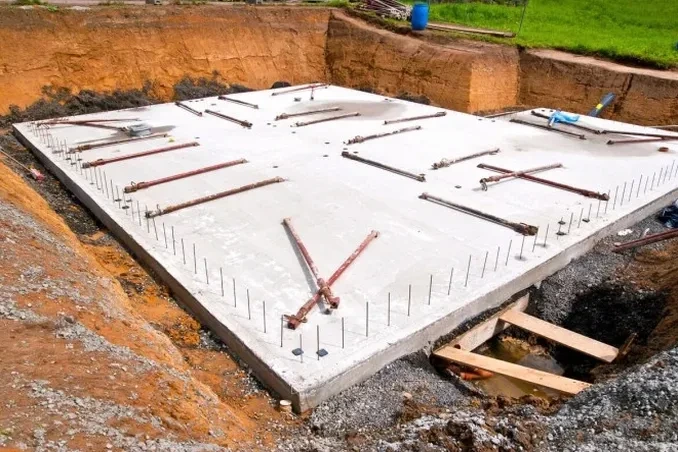
The ground beneath your feet in Southampton changes dramatically between the city centre and the outer suburbs. Over in Shirley and Freemantle, you'll often find the stiff, overconsolidated clays of the Bracklesham Beds that offer a decent bearing stratum from the surface, making foundation selection unusually straightforward for a coastal city. But move east towards Bitterne or down into the floodplains of the River Itchen, and you hit an entirely different beast: metres of soft, normally consolidated alluvium interbedded with peat lenses that compress under load like a sponge. We see this contrast play out in almost every project that crosses the city, which is why a properly configured raft/mat foundation design becomes not just an option but frequently the most economical way to bridge the variable ground. Rather than fighting the soil with deep piles through these compressible layers, a stiffened raft distributes the structural load across a wide footprint and limits differential settlement to tolerances the superstructure can handle. When we combine this approach with a targeted ground investigation — a CPT test through the Itchen alluvium gives us a continuous strength profile that calibrated boreholes can't match — the design stops being guesswork and becomes a rational engineering solution tuned to Southampton's specific stratigraphy.
A raft foundation in Southampton's alluvial clays isn't about avoiding settlement — it's about making settlement uniform enough that the building never knows it moved.
Technical details of the service in Southampton
Risks and considerations in Southampton
The CPT rig that rolls onto a Southampton site looks deceptively compact — a twenty-tonne truck with a hydraulic pushing system that can drive a cone penetrometer through soft ground at a steady two centimetres per second, recording tip resistance, sleeve friction, and pore water pressure every ten millimetres. But what that machine reveals about the subsurface is where the real weight of the project sits. In the alluvial corridors of the Itchen and Test, we've watched the cone resistance drop from six megapascals to less than half a megapascal over a vertical distance of just thirty centimetres, marking the transition into a peat lens that would concentrate differential settlement directly under a lightly loaded corner of a raft. Missing that layer — and we've seen it missed on sites where only boreholes were used, because peat can be thinner than the sampling interval — means the raft foundation design will underestimate the curvature the slab experiences in service. That curvature drives cracking in blockwork, jamming of doors, and serviceability failures that cost far more to remediate than the investigation that would have caught the problem. Southampton's tidal influence adds another dimension: the groundwater in the gravels fluctuates by nearly two metres between spring tides and neaps, and a raft that sits partly in the capillary zone will see the upper clays soften and stiffen on a fortnightly cycle that most design models never simulate.
Our services
The raft foundation design process in Southampton draws on several interrelated geotechnical and structural disciplines, and we've structured our service offering so that clients can engage the full package or individual components depending on the project stage.
Geotechnical interpretative reporting for raft design
We compile borehole logs, CPT profiles, and laboratory test results into a single geotechnical model that defines the design soil parameters for each stratum. This report becomes the contractual basis of the raft foundation design and is prepared in accordance with BS EN 1997-2.
Settlement analysis and raft stiffness optimisation
Using finite element or subgrade reaction models calibrated to Southampton's ground conditions, we predict total and differential settlement under service loads and iterate the raft thickness, stiffening beam layout, and concrete grade to meet the project's movement criteria.
Ground investigation supervision for raft projects
We direct the drilling, sampling, and in-situ testing programme to ensure the investigation reaches the depth and density required for a reliable raft design, including specific protocols for sampling the soft alluvium and peat layers that control settlement behaviour.
Construction-phase support and raft monitoring
We offer technical oversight during excavation, blinding, and reinforcement placement, plus settlement monitoring using precise levelling for the first twelve months post-construction to verify that the raft performs within the predicted envelope.
Questions and answers
What does a raft foundation design typically cost for a Southampton project?
For a residential or light commercial structure on a typical Southampton site, the full raft/mat foundation design package — covering geotechnical interpretation, settlement modelling, structural design of the slab, and construction drawings — generally falls between £760 and £3,080 depending on the complexity of the ground conditions and the building geometry. Sites with highly variable alluvium or requiring finite element analysis will sit at the upper end of that range.
When is a raft foundation preferable to piles in Southampton's ground conditions?
A raft becomes the better choice when the competent bearing stratum — typically the Bracklesham Beds — sits at a depth where piling becomes expensive but the near-surface soils have enough stiffness to support a wide foundation with acceptable settlement. In practice, we see this decision point around four to six metres of soft cover over the stiff clays. The raft also performs well where the soft layer thickness varies across the site, because it can bridge differential stiffness more efficiently than isolated pad footings tied with ground beams.
How deep do you need to investigate for a raft foundation design in Southampton?
BS EN 1997-1 requires the ground investigation to extend to a depth where the stress increase from the raft becomes negligible — typically 1.5 to 2 times the raft width. For a 12-metre-wide raft on the Itchen alluvium, that means boreholes or CPT soundings reaching 18 to 25 metres below ground level, penetrating fully through the soft deposits and into the underlying Bracklesham or London Clay formation to characterise the compressible layers completely.
How do Southampton's tidal groundwater levels affect raft foundation performance?
The twice-daily tidal fluctuation in the River Itchen and Southampton Water propagates through the gravel aquifer that underlies much of the city's southern and eastern districts, causing the phreatic surface to oscillate by one to two metres. A raft founded partly above this zone experiences cyclic wetting and drying of the upper clay crust, which alters its stiffness on a short-term cycle. Our designs account for this by using the worst-case softened strength for bearing checks and by specifying sulfate-resistant concrete where the groundwater chemistry — influenced by the estuarine environment — demands it.