In Southampton, a city built largely on the Bracklesham Group and London Clay formations with significant thicknesses of soft alluvium in the river valleys, the assumption that the UK is aseismic can be a costly oversimplification. While seismicity is low to moderate, the combination of deep soft soil deposits and a high water table — the River Test and River Itchen define the city's geography — creates conditions where ground motion amplification becomes a genuine design consideration for critical infrastructure. The research by Skipp (1991) on UK seismic hazard, still referenced in British practice, underscores that sites with more than 30 metres of soft clay can amplify long-period motions exactly where base isolation is most effective. When a new hospital wing or a data centre in the docks area requires resilience beyond conventional ductile design, base isolation seismic design shifts from an academic exercise to a practical necessity, and specifying it correctly demands integration with a thorough ground investigation programme that characterises the soil profile down to the underlying chalk at depth.
On the soft alluvium of the Test and Itchen valleys, base isolation must counteract both the seismic input and the site amplification that turns a distant tremor into a resonant structural demand.
Technical details of the service in Southampton
Risks and considerations in Southampton
BS EN 1998-5 requires that the supporting soil not liquefy or lose strength under the design earthquake, a criterion that becomes particularly relevant where the Southampton alluvium contains loose saturated silts and sands. Even though the UK seismic hazard is modest, the soft soil amplification can produce spectral accelerations significantly higher than the bedrock reference value, and if the isolator displacement is underestimated due to an over-optimistic ground model, the superstructure can impact the moat wall, bypassing the protection entirely. A further risk specific to friction pendulum systems on clay sites is differential settlement of the supporting plinths, which alters the concave sliding surface geometry and changes the effective radius of curvature, invalidating the assumed force-displacement relationship. The team responsible for base isolation seismic design in Southampton verifies the complete load path — from the superstructure columns through the isolator connections, into the transfer structure, and down to the piles or raft — using nonlinear time-history analyses with ground motions spectrally matched to the site-specific response spectrum derived from a BS 5930 compliant ground model.
Our services
Base isolation seismic design in Southampton is delivered through a sequence of interconnected technical activities that span from initial ground characterisation to the final peer review of the isolator specification and structural analysis.
Site-specific seismic hazard assessment
Development of uniform hazard spectra and site response analyses using the UK seismic hazard model, incorporating the depth to the chalk bedrock and the dynamic properties of the overlying Bracklesham Group and alluvial soils encountered in the Southampton area.
Isolator system selection and specification
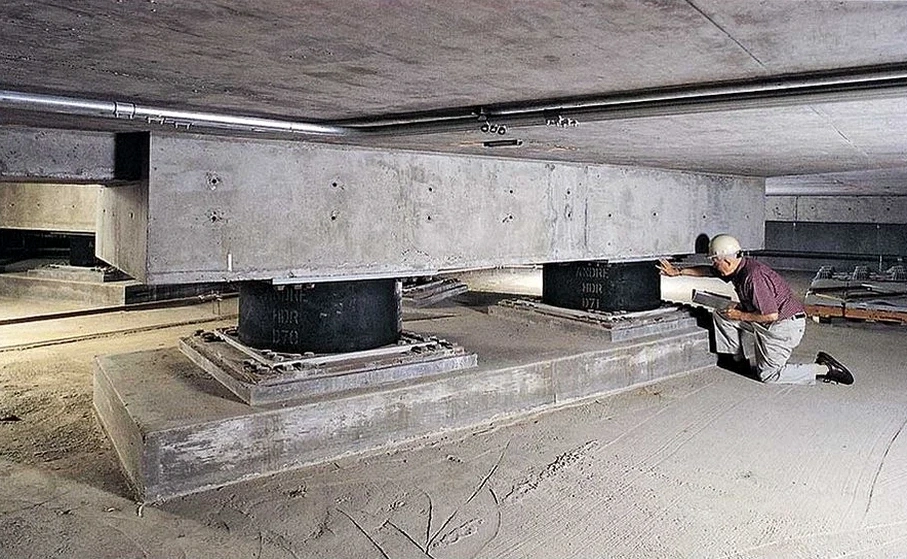
Comparative assessment of high-damping rubber bearings, lead rubber bearings, and friction pendulum systems against the project performance criteria, with full design documentation to EN 15129 and the relevant parts of Eurocode 8.
Nonlinear time-history structural analysis
Three-dimensional modelling of the isolated structure using spectrally matched ground motion suites, verifying inter-storey drifts, isolator displacements, and substructure forces for the ULS and SLS seismic actions.
Prototype testing and production oversight
Witnessing of type tests and factory production control tests on isolator samples, ensuring compliance with the declared design properties before installation on the Southampton project site.
Questions and answers
Is base isolation seismic design required by UK building regulations for a project in Southampton?
The Building Regulations 2010 (Approved Document A) refer to Eurocode 8 for seismic design, but the UK National Annex classifies most of the country, including Southampton, as a very low seismicity region where seismic design to BS EN 1998 may not be required for ordinary structures. However, for hospitals, emergency response facilities, and other structures in Consequence Class CC3 where post-earthquake functionality is essential, the client or insurer may specify enhanced resilience, and base isolation seismic design becomes a voluntary performance-based strategy rather than a prescriptive requirement.
What type of ground investigation is needed before designing a base isolation system in Southampton?
A comprehensive investigation to BS 5930:2015+A1:2020 is essential, extending to the chalk bedrock which can be at depths of 30 to 60 metres in the Test and Itchen valleys. The investigation must include downhole seismic testing or crosshole tests to measure shear wave velocity profiles for site classification, CPT or SPT data for liquefaction assessment of any loose saturated sands within the alluvium, and high-quality sampling with laboratory dynamic triaxial or resonant column tests to define stiffness degradation and damping curves for the site response analysis.
What is the typical cost range for a base isolation seismic design package for a medium-sized building in Southampton?
For a complete base isolation seismic design package covering the hazard assessment, isolator specification, and structural analysis for a medium-sized building in Southampton, the fee typically ranges from £3,270 to £6,420 depending on the structural complexity and the number of isolator types involved. This excludes the cost of the isolator devices themselves and the ground investigation, which are separate procurement items.
How does the soft ground in Southampton affect the performance of friction pendulum isolators?
Friction pendulum isolators transfer the lateral load through a sliding interface where the effective stiffness is proportional to the supported weight divided by the radius of curvature, making them theoretically insensitive to the superstructure mass. However, on the deep soft clay deposits common in Southampton, the primary concern is that the substructure must remain essentially rigid relative to the isolators — if the foundation system settles differentially by even 10 to 15 mm, the concave plates lose their design geometry and the restoring force can deviate from the bilinear hysteresis assumed in the analysis. The solution typically involves a stiff piled raft or a cellular transfer structure designed to limit relative displacements to within the manufacturer's installation tolerances.